Mini Golf Business Ideas in Australia: Why Venues Are Investing in 2026

mini golf business

Mini golf has quietly become one of the smartest commercial investments available to venue operators in Australia. Golf clubs, holiday parks, councils and private developers are adding courses not as a novelty — but as a genuine, long-term revenue stream that pays for itself and keeps delivering.

If you’re exploring mini golf as a business idea, here’s what the opportunity actually looks like in 2026.

Is mini golf a good business in Australia?

The numbers say yes. According to Golf Australia’s 2023 Participation Report, over 2 million Australians now play off-course golf — a category that includes mini golf alongside driving ranges. That’s a large, growing audience actively looking for accessible, social, family-friendly experiences.

What makes mini golf particularly attractive as a business is its broad appeal. It doesn’t require a specific skill level, age group, or budget. Families, couples, corporate groups, school excursions and grey nomads can all play — and enjoy it. That inclusivity translates directly into consistent foot traffic across seasons and demographics.

As Geoff Bennell, founder of Mini Golf Creations, puts it: “People are using mini golf to build a place where they can eat, drink and have fun.” That’s the real business model — mini golf as the anchor that drives broader venue spend.

What kind of venues are adding mini golf?

The range of operators investing in mini golf right now is broader than most people expect.

Golf clubs and resorts are using it to attract non-golfers — partners, children and younger visitors who wouldn’t otherwise engage with the venue. A well-designed course extends the club’s appeal without compromising its existing offering.

Holiday parks and caravan parks are finding mini golf drives bookings and repeat stays. Families choose parks with more on-site activities, and mini golf is one of the most universally enjoyed. It fills afternoons, keeps kids engaged and gives parents a reason to stay put rather than drive elsewhere.

Local councils and regional operators are investing in mini golf as part of tourism infrastructure. A quality course gives visitors a reason to extend their stay, fills the off-season calendar, and generates economic activity that flows through to local accommodation, food and retail.

Private developers and entertainment venues are building standalone mini golf experiences or integrating courses into broader family entertainment centres — combining mini golf with food and beverage, arcade games and events spaces to create a full-day destination.

Each of these models works. The right approach depends on your site, your existing offering and your revenue goals.

What does the revenue model look like?

Mini golf generates income in several ways, not just ticket sales.

The primary revenue stream is green fees — typically charged per person per round. Pricing varies by venue type and location, but Australian courses generally charge between $12 and $22 per adult and $8 to $15 per child.

The secondary revenue streams are often just as significant. Mini golf drives:

  • Increased food and beverage spend — players stay longer and spend more at the café, bar or restaurant
  • Private bookings and events — birthday parties, corporate team-building, school groups and community events
  • Seasonal programming — themed nights, glow golf events, holiday activations
  • Membership or loyalty programs for high-frequency local visitors

When you add those streams together, the commercial case becomes compelling. Mini Golf Creations offers a revenue calculator that lets you model projected returns based on your venue type and expected visitation — a useful starting point before committing to a build.

How long does it take to see a return on investment?

This varies depending on the scale of the investment and the volume of visitors your venue attracts. However, well-designed courses in high-traffic locations typically begin generating strong returns within the first two to three years of operation.

The key factors that affect ROI are design quality, location, marketing and integration with your existing venue offering. A course that’s bolted on as an afterthought will underperform. A course that’s designed as a genuine centrepiece — with good flow, strong theming and proper integration with food and beverage — will outperform expectations.

What does it cost to start a mini golf business in Australia?

Construction costs vary based on size, complexity, site conditions and finish quality. A compact 9-hole course sits at a different investment level to a fully landscaped, themed 18-hole facility.

What’s consistent is that mini golf remains one of the more accessible leisure attractions to build and operate. Compared to a waterpark, climbing centre or large-scale entertainment facility, the capital requirement is relatively modest — and the ongoing maintenance costs are low once the course is built properly from the start.

Detailed information on mini golf construction costs in Australia is available on the Mini Golf Creations website, along with guidance on what to budget for different venue types and scales.

What makes mini golf recession-resilient?

One of the less-discussed strengths of mini golf as a business is its performance during economic downturns. When household budgets tighten, families look for affordable, local entertainment options rather than expensive holidays or outings. Mini golf fits that profile almost perfectly — it’s low cost, close to home, and delivers genuine enjoyment.

The International Association of Miniature Golf consistently points to mini golf’s resilience as a leisure category globally, noting that participation holds steady or grows during periods of economic uncertainty. For venue operators looking for a stable, long-term investment, that’s a meaningful consideration.

How do you get started?

The first step is understanding what’s possible for your specific site and venue type. Mini Golf Creations works with operators across Australia and internationally — from initial feasibility conversations through to design, construction and opening day.

Whether you have a fully formed plan or just an idea worth exploring, the team is happy to talk it through.
Mini Golf Course Design in Australia: What You Need to Know Before You Build

mini golf course design Australia

If you’re considering adding a mini golf course to your venue, you’re not alone. Golf clubs, councils, holiday parks and private developers across Australia are investing in mini golf at a rate not seen before. And the reasons are straightforward — it works commercially, it appeals to everyone, and when it’s designed well, it pays for itself.

But design is everything. A poorly planned course frustrates players, costs more to maintain, and underperforms from day one. A well-designed course becomes an asset that generates revenue for decades.

Here’s what you need to understand before you build.

What makes a good mini golf course design?

Good mini golf course design balances three things: playability, commercial performance, and place.

Playability means the course is genuinely enjoyable for every skill level — from a five-year-old on their first visit to an experienced golfer looking for a real challenge. The best courses offer multiple ways to play each hole, so nobody feels locked out of the fun.

Commercial performance means the layout works for your business. That includes efficient flow so groups don’t back up, easy supervision with minimal staffing, and a design that encourages repeat visits rather than a one-and-done experience.

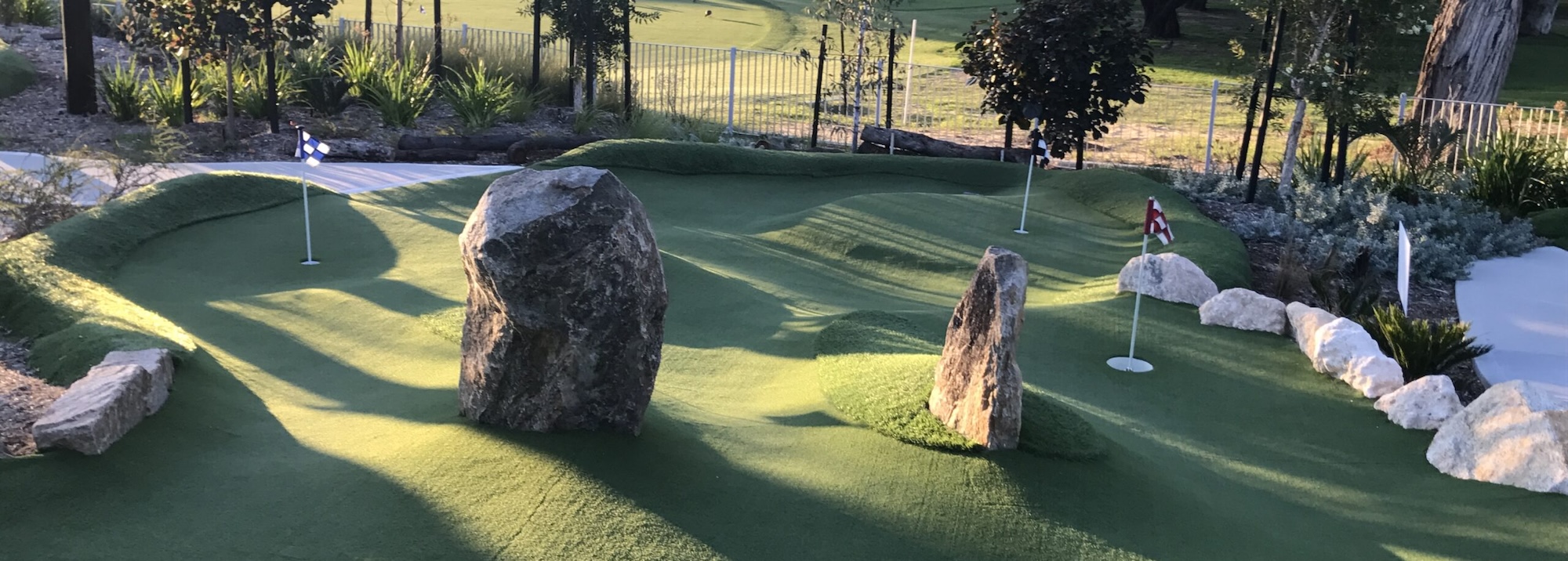
Place means the course feels like it belongs where it’s built. A coastal course in Queensland should feel different to one built in the Victorian high country or at a resort in the Whitsundays. Custom landscaping, local materials, and thoughtful theming are what separate a memorable course from a generic one.

At Mini Golf Creations, every course starts with a detailed site assessment and design process that considers all three. No two courses are the same.

How much space do you actually need?

One of the most common questions from venue operators is around footprint. The good news is that mini golf is more flexible than most people assume.

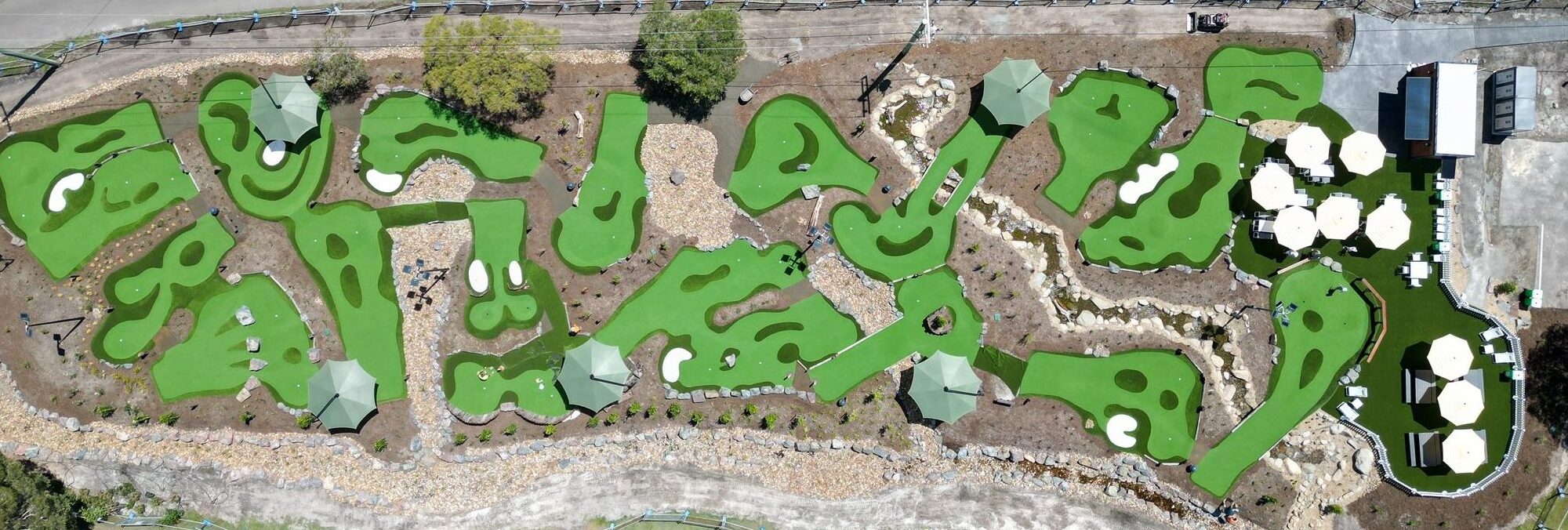
A standard 18-hole commercial course typically requires around 2,000–2,500 square metres. But compact urban designs and 9-hole formats can work in much smaller footprints — as little as 500–800 square metres for the right layout.

Holiday parks, golf clubs with unused land, council showgrounds, and resort precincts often have more viable space than they realise. The key is working with a designer who can assess the site properly rather than applying a one-size-fits-all template.

For venues with tighter spaces, pop-up mini golf is also worth considering — a lower-commitment way to test the concept before committing to a permanent build.

What does mini golf course construction actually involve?

Construction typically takes between 14 and 20 weeks from design sign-off to opening day. The process covers site preparation, base construction, turf installation, obstacle and feature builds, landscaping, and finishing.

The quality of materials matters enormously for long-term performance. Synthetic turf selection, drainage design, and the durability of obstacles all affect how the course holds up over time — particularly in Australia’s variable climate, from tropical north Queensland to cold southern winters.

You can read more about weather-resilient course design here — it’s one of the most overlooked aspects of the planning process.

Who is building mini golf courses in Australia right now?

The short answer: a wide range of operators.

Golf clubs are adding mini golf to attract non-golfer family members and younger audiences who wouldn’t otherwise visit. Resorts are using it to increase on-property dwell time and reduce the need for guests to leave the venue. Regional councils are investing in mini golf as part of broader tourism infrastructure — giving visitors a reason to stay longer and spend more locally. Holiday parks are finding it drives bookings and repeat stays, particularly during school holidays.

According to Golf Australia’s 2023 Participation Report, over 2 million Australians now play off-course golf — a figure that includes mini golf alongside driving ranges. That’s a large and growing audience that operators are increasingly competing to attract.

For a deeper look at the commercial case, the International Association of Miniature Golf tracks participation trends globally and consistently points to mini golf’s resilience as a leisure category even during economic downturns.

What does it cost to build a mini golf course in Australia?

Cost varies considerably based on scale, complexity, site conditions and finish quality. A basic 9-hole course will sit at a different price point to a fully landscaped, themed 18-hole facility.

What’s consistent across all projects is that the return on investment is strong when the course is designed properly. Venues report increased food and beverage sales, higher visit frequency, and stronger off-season performance once a quality course is in place.

Mini Golf Creations publishes detailed information on mini golf construction costs as well as a revenue calculator that lets you model projected returns based on your venue type and expected visitation — a useful starting point before any formal conversations.

Should you renovate an existing course or start fresh?

If you already have a mini golf course that’s underperforming, the answer isn’t always to demolish and rebuild. In many cases, a targeted renovation — new turf, updated obstacles, improved landscaping — can transform the player experience at a fraction of the cost of a new build.

The tell-tale signs a course needs attention: worn or patchy turf, obstacles that no longer function properly, a layout that feels dated, and declining repeat visitation. If any of those sound familiar, it’s worth getting an assessment done.

Getting started

The best first step is a conversation. Mini Golf Creations works with golf clubs, councils, holiday parks, resorts and private developers across Australia and internationally — from initial concept through to opening day.

If you have a site in mind, or even just an idea you want to test, get in touch with the team directly.

How Mini Golf Activates Regional Destinations and Drives Visitor Economy Growth

Mini Golf as a Tourism Magnet for Regional Destinations in Australia

Regional and rural destinations across Australia and New Zealand face a common challenge: how to attract visitors beyond peak seasons and encourage them to stay longer.

Tourism strategies often focus on natural assets or heritage experiences. But increasingly, local councils and operators are recognising the value of adding interactive attractions that complement existing drawcards.

Mini golf is emerging as one of those solutions.

Not because it is novel, but because it is accessible, scalable and commercially practical.

Why mini golf works in regional tourism in 2026

Mini golf succeeds in regional settings for three key reasons:

  1. It appeals across generations
  2. It requires a modest footprint
  3. It integrates easily with hospitality and events

Unlike niche attractions, mini golf does not depend on a specific demographic. Families, grey nomads, school groups, corporate retreats and young travellers can all participate.

That inclusivity makes it a reliable addition to regional tourism infrastructure.

Turning underutilised land into a destination asset

Many regional areas have underused parcels of land near caravan parks, golf clubs, showgrounds or town centres.

A well-designed mini golf course can transform these areas into active, revenue-generating spaces.

Rather than simply filling space, modern courses are designed to:

  • Encourage longer dwell time
  • Support food and beverage sales
  • Host community events
  • Provide off-season activity
  • Complement existing tourism assets

Mini golf becomes part of a broader visitor economy ecosystem rather than a standalone attraction.

Encouraging overnight stays and extended visitation

Tourism operators understand the importance of length of stay.

Mini golf contributes by offering an activity that fills gaps between other experiences. Visitors who may have planned a short stop can justify staying an additional night when there are multiple recreational options available.

That extended visitation benefits:

  • Local accommodation providers
  • Cafés and restaurants
  • Retail businesses
  • Event organisers
  • Tourism operators

The economic impact extends well beyond ticket sales.

Strengthening regional identity through design in 2026

Modern mini golf courses are not generic layouts.

Custom course design allows destinations to reflect local character through landscape, materials and storytelling.

Courses can incorporate:

  • Coastal themes in beachside towns
  • Outback or mining heritage elements
  • Agricultural references in farming regions
  • Natural rock and bushland features
  • Indigenous cultural storytelling

This approach ensures the attraction feels authentic rather than imported.

Mini Golf Creations specialises in designing courses that reflect place, not just play.

Learn more about our design process here:
https://minigolfcreations.com/construction/our-design-and-process/

Driving repeat visitation and community engagement

Tourism is not only about attracting outsiders. It is also about giving locals reasons to stay engaged with their own region.

Mini golf supports:

  • School holiday programming
  • Community competitions
  • Seasonal themed events
  • Fundraisers and local partnerships

When locals adopt an attraction as their own, it becomes sustainable beyond peak tourism cycles.

A practical investment for regional operators

Compared to large-scale attractions, mini golf offers a manageable investment profile.

Modern construction techniques, durable materials and efficient layouts allow for long-term performance with relatively low ongoing maintenance.

For councils, golf clubs and regional developers, this balance of affordability and impact is critical.

Mini golf does not need to be oversized to be successful.

Frequently Asked Questions

1. Is mini golf good for regional towns in Australia?
Yes—it’s inclusive for all ages, needs little space, works year-round, and boosts local spending on accommodation, food and retail by encouraging longer stays and off-season visits.

2. How much does a mini golf course cost for a rural area?
Far less than big attractions. Modern, durable designs from companies like Mini Golf Creations offer good ROI with low ongoing maintenance—ideal for councils, caravan parks or golf clubs on tight budgets.

3. Can mini golf fit local themes in regional Australia or NZ?
Absolutely. Custom courses can include coastal, outback, farming, bushland or Indigenous elements so it feels authentic to the town, builds community pride, and drives repeat local and tourist visits.

Find out more about our mini golf construction, mini golf course design,  mini golf turf, mini golf renovation, pop up mini golf, and our mini golf revenue calculator.

How Mini Golf Evolved in Australia — And Why It Matters in 2026

Mini Golf course Australia

Mini golf in Australia did not grow by accident. Its evolution mirrors broader changes in how Australians spend leisure time, how venues compete, and how recreational spaces generate revenue.

Understanding that evolution helps explain why mini golf is now considered a serious commercial asset rather than a novelty attraction.

From backyard putting greens to commercial precincts

Early miniature golf in Australia was simple. Small sand or turf layouts, basic obstacles, and a strong focus on casual recreation defined the early years.

But mini golf was never static.

As suburbs expanded and family entertainment became more structured in the 1960s and 70s, courses became more creative. Artificial turf allowed for durability. Structured obstacles introduced play variety. The experience became less about practice and more about participation.

By the 1980s and 90s, mini golf had shifted again. Indoor centres emerged. Retail and entertainment precincts began integrating courses as part of larger offerings. Mini golf moved closer to hospitality.

The shift from novelty to strategy

The biggest change in Australian mini golf has occurred in the last 15 years.

Courses are no longer being built simply as add-ons. They are being designed as revenue engines.

Instead of flat novelty layouts, many modern builds focus on:

  • Contoured putting surfaces
  • Realistic golf cup placement
  • Integrated landscaping
  • Durable construction
  • High-quality drainage systems
  • Visual appeal suitable for social media

The objective is no longer just to entertain children. It is to attract families, corporate groups, young adults, and golf club members in equal measure.

Mini golf has evolved from pastime to business model.

Why Mini Golf evolution matters for venues in 2026

Today’s venue operators compete for discretionary spending. Entertainment dollars are not limited to traditional golf clubs or recreation centres. They compete with dining precincts, cinemas, competitive socialising venues, and experience-based attractions.

Mini golf succeeds in this environment because it is:

  • Accessible to all ages
  • Social and group-friendly
  • Compact in footprint
  • Relatively low maintenance
  • Capable of driving ancillary spend

That evolution did not happen overnight. It reflects decades of adaptation.

The Australian difference

In Australia, mini golf has developed a distinct identity.

While novelty putt putt remains popular, there has been growing demand for contoured, landscaped mini golf that mirrors real golf in miniature form.

This approach appeals to traditional golfers while remaining welcoming to first-time players.

It also aligns more closely with golf clubs and councils seeking a premium, integrated experience rather than a temporary attraction.

Where Mini Golf Creations fits in

Mini Golf Creations emerged during this modern phase of mini golf development.

With a foundation in golf course turf management and landscaping, the business evolved from installing backyard putting greens to delivering large-scale commercial mini golf courses across Australia.

The focus has always been on building courses that feel intentional, durable and commercially viable.

Modern Australian mini golf requires:

  • Technical construction knowledge
  • Drainage and surface expertise
  • Creative theming without gimmicks
  • Long-term performance planning

That is where experience matters.

Learn more about our construction and design approach here:
https://minigolfcreations.com/construction/our-design-and-process/

The next chapter of mini golf in Australia

Mini golf continues to adapt.

Current trends shaping the industry include:

  • Sustainable materials and water-efficient landscaping
  • Integration into hospitality precincts
  • Social media-driven visual design
  • Hybrid spaces combining food, drink and play
  • Night-time activation with lighting and programming

The game may be small in scale, but its commercial and cultural impact continues to grow.

Mini golf in Australia has moved far beyond its early sand-based layouts. It now occupies a serious place in the leisure economy.

For venues considering a build or upgrade, understanding that evolution helps clarify one thing:

Mini golf is not just history. It is an opportunity.

Frequently Asked Questions

1. How has mini golf changed in Australia over the years?
Mini golf started as simple backyard or sand-based putting greens focused on casual fun. From the 1960s–70s, artificial turf and creative obstacles made it more durable and engaging. By the 1980s–90s, indoor centres and precinct integrations turned it into part of hospitality. In the last 15 years, it’s become a strategic revenue driver with contoured surfaces, landscaping, social-media appeal, and broad audience targeting—evolving from novelty to a serious business model.
2. What makes Australian mini golf different from other countries?
Australia has moved beyond classic novelty “putt-putt” toward contoured, landscaped courses that mimic real golf in miniature. This appeals to serious golfers and beginners alike, and integrates well with golf clubs, councils, and premium venues seeking a high-quality, long-term attraction rather than a temporary gimmick. The focus is on durability, realistic play, and commercial viability.

3. What are the biggest mini golf trends in Australia for 2026?
Current and upcoming trends include sustainable materials and water-efficient landscaping, integration into hospitality and dining precincts, designs optimised for social media photos, hybrid food-drink-play spaces, and night-time activation with creative lighting. These make mini golf more immersive, inclusive, and profitable as part of the broader leisure and entertainment economy.

Contact Mini Golf Creations for more information

Find out more about our mini golf construction, mini golf course design,  mini golf turf, mini golf renovation, pop up mini golf, and our mini golf revenue calculator.

When is it time to renovate your mini golf course?

Mini Golf Course Renovation

Mini golf has been part of the entertainment landscape for decades, but expectations have changed. Today’s players want more than novelty obstacles and worn turf. They want immersive design, quality finishes, and an experience worth sharing.

If your course is showing its age, a renovation or remodel can do far more than freshen the look. When planned properly, it can reposition your venue, increase revenue, and extend the life of your investment.

This article explores why mini golf renovations matter in today’s market and how Mini Golf Creations approaches upgrades with both playability and commercial performance in mind.

Why mini golf renovations are becoming essential in 2026

Older mini golf courses were often designed with simplicity in mind. Flat surfaces, basic obstacles, and limited theming were once enough to attract players. That is no longer the case.

Venues now compete with a wide range of entertainment options including immersive experiences, dining precincts, and social attractions. Mini golf needs to stand confidently alongside these offerings.

A renovation allows you to respond to changing visitor expectations while retaining the character and footprint of your existing course.

How a mini golf renovation improves the player experience

Player experience is the foundation of repeat visitation. A well renovated course feels intentional, easy to navigate, and engaging from the first hole to the last.

Upgrades can include improved flow between holes, refined putting surfaces, enhanced landscaping, and obstacles that introduce variety without frustration. When players enjoy the experience, they stay longer, return more often, and recommend the venue to others.

Mini Golf Creations focuses on designing upgrades that balance challenge with accessibility so the course remains enjoyable for all ages.

Keeping pace with modern design trends in 2026

Mini golf design has evolved significantly. Today’s courses often feature contoured greens, integrated water elements, bridges, tunnels, and creative terrain rather than flat layouts.

Renovating your course provides an opportunity to introduce contemporary design features while improving durability and maintenance efficiency. It also allows older courses to align visually with newer hospitality or precinct developments around them.

Staying current helps ensure your course feels relevant rather than dated.

Increasing revenue through smarter course upgrades

A mini golf renovation is not just a cosmetic upgrade. When designed strategically, it supports new revenue streams and stronger commercial performance.

Upgraded courses often see increased demand for group bookings, birthday parties, corporate events, and school holiday activations. A refreshed experience also supports stronger food and beverage spend by encouraging longer dwell times.

Mini Golf Creations designs renovations with these outcomes in mind, ensuring the course works as part of a broader venue ecosystem rather than a standalone attraction.

Using theming to stand out in a competitive market

Theming plays a major role in how a mini golf course is perceived. A well executed theme creates a sense of place and gives visitors something to remember.

Renovations are the ideal time to refine or completely rethink theming. Whether subtle and landscape driven or bold and immersive, themes help differentiate your course from others in the region.

Strong theming also supports marketing, signage, merchandise opportunities, and special events without overwhelming the play experience.

Improving accessibility and sustainability during renovations

Renovation projects offer the chance to improve both inclusivity and sustainability.

Accessible pathways, smoother transitions, and thoughtful layouts allow players of all abilities to enjoy the course. At the same time, sustainable design choices such as low maintenance surfaces, water efficient landscaping, and energy conscious lighting can reduce long term operating costs.

Mini Golf Creations prioritises practical sustainability measures that deliver real benefits rather than superficial add ons.

Renovating versus rebuilding a mini golf course

In many cases, a full rebuild is not necessary. Renovation allows venues to retain existing infrastructure while addressing the elements that limit performance or appeal.

A professional assessment can determine whether targeted upgrades or a more comprehensive remodel will deliver the best outcome. The goal is always to maximise return on investment while minimising disruption.

How Mini Golf Creations approaches renovations

Mini Golf Creations has extensive experience upgrading and remodelling mini golf courses across Australia. Our approach starts with understanding how your course is currently used, where it underperforms, and what opportunities exist for improvement.

We design renovations that integrate seamlessly with your site while introducing modern play elements, improved durability, and stronger visual appeal. Every upgrade is planned with long term performance in mind.

You can learn more about our design and construction approach

Frequently Asked Questions

1. How much does it cost to renovate a mini golf course in Australia?

Renovation costs vary widely depending on the course size, current condition, scope of upgrades (e.g., new theming, contoured surfaces, water features, or accessibility improvements), and location factors like materials and labor. Targeted refreshes might start from tens of thousands, while comprehensive remodels with modern design elements can range higher. Mini Golf Creations provides customised quotes after assessing your site to maximise ROI without unnecessary expense—contact us for a no-obligation discussion tailored to your venue.

2. How long does a mini golf course renovation typically take?

It all depends on the scale—from minor upgrades like surface refinishing and theming tweaks to full remodels involving new obstacles, landscaping, and sustainability features. We minimise disruption by planning phased work where possible, so your course can often stay partially operational or reopen quickly.

3. What are the main benefits of renovating an existing mini golf course instead of building a new one?

Renovating lets you keep your existing footprint, infrastructure, and location advantages while dramatically improving player experience, modernising design, boosting revenue through longer visits, group events, and higher F&B spend, and extending your investment’s lifespan. It’s usually more cost-effective and less disruptive than a full rebuild.

Is it time to renovate your mini golf course?

If your course feels tired, struggles to attract repeat visitors, or no longer reflects the quality of your venue, renovation is worth considering.

A well planned mini golf upgrade can refresh your brand, improve guest experience, and unlock new revenue opportunities without starting from scratch.

To explore renovation options or discuss whether your course is ready for an upgrade, speak with the team at Mini Golf Creations.

Find out more about our mini golf construction, mini golf course design,  mini golf turf, mini golf renovation, pop up mini golf, and our mini golf revenue calculator.

Small Mini Golf Course Design for Urban Commercial Spaces

Small Mini Golf Course Design for Urban Commercial Spaces


As cities become denser and commercial real estate becomes more competitive, entertainment venues must do more with less.
Mini Golf Creations specialises in creating compact yet unforgettable mini golf experiences tailored for urban environments.
From rooftop attractions to narrow commercial lots, smart design can transform limited square footage into a profitable,
visually striking destination that keeps players coming back.

The Growing Demand for Compact Mini Golf Experiences

Urban centres thrive on foot traffic, social engagement, and unique attractions. Small mini golf courses are perfectly suited
for these environments because they deliver high entertainment value without requiring expansive land.
Restaurants, mixed-use developments, shopping centres, and hotels increasingly look to mini golf as a way to extend dwell time,
drive repeat visits, and create memorable guest experiences.

With thoughtful miniature golf course design, even the smallest footprint can feel
dynamic, immersive, and premium. The key is planning that balances playability, flow, durability, and visual impact
while supporting long-term operational success.

Designing for Small Commercial Lots

Limited space doesn’t mean limited creativity. Designing mini golf for small commercial lots requires a deep understanding
of spatial efficiency and player movement. Courses must guide guests smoothly from hole to hole while avoiding congestion,
blind spots, or awkward transitions.

Mini Golf Creations focuses on layouts that maximise every square foot. Strategic angles, curved pathways, and shared visual
sightlines make compact courses feel larger than they are. Clear entry and exit points also help maintain steady throughput,
which is essential for busy urban venues.

In smaller outdoor lots, noise control, lighting, and durability become even more important. Materials and finishes must
withstand constant use while complementing the surrounding architecture and branding.

Rooftop Mini Golf: Elevating Entertainment

Rooftop mini golf has become one of the most exciting trends in urban entertainment. These elevated courses transform unused
rooftop space into revenue-generating attractions with panoramic views, strong social media appeal, and built-in exclusivity.

Designing for rooftops requires specialised knowledge of weight limits, drainage, wind exposure, and safety regulations.
Multi-level hole designs, lightweight modular obstacles, and integrated seating areas help create a seamless rooftop experience
that feels intentional rather than improvised.

Mini Golf Creations ensures rooftop courses are engineered for performance and longevity, while still delivering the playful,
imaginative elements that guests expect from modern mini golf.

Modular Obstacles for Maximum Flexibility

Modular obstacles are a cornerstone of small mini golf course design. These prefabricated elements allow courses to be built,
expanded, or reconfigured with minimal disruption. For urban spaces where change is constant, modularity provides long-term
flexibility.

Operators can refresh their course seasonally, rotate obstacles to maintain interest, or adapt layouts for private events.
Modular designs also streamline mini putt construction timelines,
reducing downtime and installation costs.

From ramps and tunnels to interactive features and themed elements, modular components enable creative expression without
sacrificing efficiency or structural integrity.

Multi-Level Layouts That Create Depth

When horizontal space is limited, vertical design becomes a powerful tool. Multi-level mini golf layouts introduce elevation
changes that add challenge, visual interest, and excitement. Raised platforms, stepped greens, and tiered obstacles give players
a sense of progression and discovery.

These designs are especially effective in urban and rooftop environments, where guests are already surrounded by vertical
architecture. By embracing height and layering, a small course can deliver the complexity and replay value of a much larger
installation.

Safety, accessibility, and clear wayfinding remain central to multi-level design, ensuring the course is enjoyable for players
of all ages and abilities.

Pop-Up Mini Golf for Urban Activations

Pop-up mini golf is an ideal solution for temporary installations, brand activations, festivals, and seasonal events.
These courses are designed for rapid setup and removal while still delivering a polished, engaging experience.

In urban commercial spaces, pop-up mini golf can activate vacant lots, plazas, or indoor spaces that would otherwise go unused.
Custom branding, interactive elements, and flexible layouts allow pop-up courses to align perfectly with marketing goals.

Mini Golf Creations designs pop-up courses that balance portability with durability, ensuring consistent performance even under
heavy foot traffic.

Designing for Revenue and Operations

A successful small mini golf course must be more than visually appealing—it must support efficient operations and strong
financial performance. Compact courses benefit from faster play times, higher turnover, and lower maintenance costs.

Strategic design decisions such as centralised queue areas, integrated point-of-sale locations, and clear sightlines help
staff manage crowds and maintain a positive guest experience. Lighting, turf selection, and obstacle materials are chosen
to minimise upkeep while preserving aesthetic quality.

By aligning design with business objectives, Mini Golf Creations helps urban operators achieve maximum return on investment
from even the smallest spaces.

Why Choose Mini Golf Creations

Mini Golf Creations brings decades of experience to the design and construction of compact mini golf courses worldwide.
The team understands the unique challenges of urban environments and delivers solutions that are creative, practical,
and built to last.

Whether you are planning a permanent rooftop attraction, a small commercial installation, or a temporary pop-up course,
Mini Golf Creations provides end-to-end support—from concept development to installation and beyond.

With a focus on innovation, quality, and guest experience, Mini Golf Creations continues to redefine what small mini golf
courses can achieve in urban commercial spaces.

Find out more about our mini golf construction, mini golf course design, mini golf turf, mini golf renovation, pop up mini golf, and our mini golf revenue calculator.


Mini golf is serious business – and it’s only getting bigger

mini golf business

Mini golf may have started as a fun-sized version of the traditional game, but in 2026, it’s a serious driver of foot traffic, revenue, and venue transformation. According to Golf Australia’s 2023 Participation Report, over 2 million Australians now play “off-course” golf – a category that includes both mini golf and driving ranges.

Mini golf isn’t just for kids or tourists anymore. As Geoff Bennell, founder of  Mini Golf Creations, explains, it has seen a major resurgence.

“It’s had a massive resurgence,” says Geoff, who has designed and built 14 courses across Australia to date.

A new kind of customer, a new kind of venue

What’s driving this growth? A shift in how families, young adults, and social groups want to spend their time and money. Instead of a traditional round of 18 holes, people are looking for something more flexible, social and accessible.

Mini Golf Creations works directly with golf clubs, councils and hospitality venues who want to create unique, commercially successful experiences that appeal to a wider audience.

“People are using mini golf to add on to their current business or to build a viable, sustainable place where people can come and eat, drink, and have fun,” Geoff explains.

Designed for fun. Built for profit.

The courses we build are not the windmill-and-clown putt putt setups of the past. These are large-scale, high-quality experiences that blend landscaping, design, and strategy.

“We have bridges, creeks, obstacles and pipework where the golf ball disappears underground and pops out somewhere else.”

Each course is designed to deliver a “wow” factor – whether you’re an experienced golfer or a first-time visitor.

“We’re always looking for something to bring that wow factor to experienced players, but also to kids and mums and dads who have never picked up a golf putter before.”

Mini Golf Creations courses average around 2,500 square metres, and take between 14 and 20 weeks to build. They’re engineered not just for fun, but for performance – with proven commercial outcomes across Australia.

Learn more about our course design process

Mini golf or putt putt – what’s the difference?

There’s often confusion between the terms “mini golf” and “putt putt,” and it’s something Geoff often explains to new clients.

  • Putt putt is often flat, novelty-style, and theme-driven – think bright colours, arcade-like experiences, and mechanical obstacles.
  • Mini golf, as designed by Mini Golf Creations, is more naturalistic, landscaped, and challenging. It mimics the flow and feel of traditional golf, scaled down for everyone to enjoy.

“[Mini golf courses] bring a slightly different challenge where you’re actually putting to the golf cup, whereas with the old style, you were ricocheting the ball off a piece of timber or something to get close to the hole.”

That distinction matters – especially when you’re investing in a long-term, multi-purpose facility that needs to appeal to broad demographics while maintaining a premium feel.

Why venues are turning to mini golf

From private golf clubs and public courses to resorts and council facilities, the addition of mini golf is proving to be a smart, future-focused investment.

The value is not just in ticket sales – it’s in the ancillary spend. Mini golf drives:

  • Increased food and beverage purchases
  • More social media sharing and brand awareness
  • Higher visit frequency
  • Stronger appeal to families, younger audiences and non-golfers

In short, mini golf makes venues more inclusive, profitable, and future-proof.

See our past projects across Australia

Get expert guidance from Australia’s most experienced mini golf builder

With over 14 large-scale courses delivered to date, Mini Golf Creations is trusted by venues that want to do things properly from day one.

Led by Geoff Bennell – a former golf course superintendent and founder of Turf Green – our team combines deep industry knowledge with end-to-end project delivery. We don’t just build mini golf courses – we create fully integrated experiences that drive commercial results.

If you’re considering mini golf at your facility, start by speaking with the experts.

Contact Mini Golf Creations to explore your vision, get answers to common questions, and take the first step.

How to Build an Eco Friendly Mini Golf Course for Eco-Conscious Customers and Sustainable Education

Mini Golf Transformation

Creating a mini golf course that appeals to today’s eco-conscious customers is not only smart business—it’s a powerful way to contribute to environmental sustainability while offering an engaging, educational, and memorable attraction. As more families, schools, and community groups look for environmentally responsible entertainment options, designing a mini golf course with sustainability at its core can help your venue stand out.

At Mini Golf Creations, we believe that thoughtful planning and smart design can transform a traditional mini golf course into an eco-friendly experience. From the initial concept stages to long-term operation, incorporating sustainable elements helps reduce environmental impact, lower operational costs, and create a unique selling point for your business.

Whether you’re planning a new course or renovating an existing site, eco-focused thinking can guide you toward responsible and innovative
mini golf design that supports a greener future.

Sustainable Materials That Make a Difference

One of the most impactful ways to build an eco-friendly mini golf course is by selecting materials that are recycled, upcycled, or sustainably sourced. Using these materials not only reduces waste but also gives your course a distinctive and thoughtful aesthetic.

  • Recycled plastics: Perfect for edging, borders, and obstacle components, recycled plastics are durable, weather-resistant, and visually appealing.
  • Reclaimed timber: Using reclaimed wood for walkways, decorative features, or bridges adds rustic charm and reduces the need for newly sourced timber.
  • Rubber surfacing: Recycled rubber can be used in safety surfacing or pathways, offering durability and sustainability in one.
  • Reused metal and stone: Old pipes, metal cut-offs, or stones from previous landscaping projects can be repurposed into creative obstacles and themed elements.

These materials help give your course an eco-inspired identity while significantly reducing your project’s environmental footprint.

Solar-Powered Lighting for Energy Efficiency

Lighting plays a major role in the overall mini golf experience. For courses that operate after sunset, choosing efficient and eco-friendly lighting solutions can reduce energy usage and maintenance costs. Solar lighting is a practical and visually striking solution.

With high-quality solar LEDs, your mini golf course can illuminate pathways, obstacles, and signage using stored solar energy—even on cloudy days. This significantly reduces electricity consumption and transforms your course into a glowing, eco-friendly showpiece at night.

Low-Water Landscaping for Sustainability and Savings

Incorporating drought-tolerant plants and water-smart landscaping is another essential component of eco-friendly course design. These choices provide a lush, natural look while keeping maintenance low and conserving water.

  • Native plants: These require less water, resist pests, and thrive in local climates—a perfect match for sustainable landscaping.
  • Drip irrigation: A targeted irrigation system helps minimise water waste while keeping plants healthy.
  • Artificial turf: High-quality mini golf turf reduces water use and maintenance demands while ensuring a premium playing surface.
  • Rainwater harvesting: Captured rainwater can be used for irrigation, cleaning, or decorative water features.

By combining these elements, your mini golf course becomes a natural showcase for sustainable landscaping principles.

Educational Value for Kids and School Groups

Eco-friendly mini golf courses naturally align with educational experiences, making them highly attractive to school groups, family outings, environmental clubs, and community groups. By integrating sustainability themes into the course design, kids learn while they play—making it both fun and meaningful.

Examples of eco-educational opportunities include:

  • Interactive signage: Explain how solar lighting works or describe the benefits of native plants.
  • Recycled-material obstacles: Use signs to teach players where these materials came from and how recycling helps the planet.
  • Themed holes: Create obstacles shaped like trees, oceans, wildlife, or renewable-energy icons to highlight sustainability topics.
  • Water-wise challenges: Showcase drought-tolerant garden beds and explain the importance of water conservation.

These features turn your mini golf course into a fun outdoor classroom—perfect for field trips and eco-education programs that schools love.

Why Eco-Friendly Courses Attract More Customers

Consumer habits are changing. People are more environmentally aware than ever, and many customers prefer attractions that align with their values. An eco-friendly mini golf course gives parents, teachers, and groups an experience they can feel good about.

In addition, sustainable design features often lead to reduced operational costs. Solar lighting, low-maintenance landscaping, and recycled materials are cost-effective long-term choices. This makes eco-friendly design both a marketing advantage and a business benefit.

For clients who want to carry these ideas into the final build, Mini Golf Creations can help bring your sustainable vision to life through thoughtful planning and expert putt putt construction techniques.

Bringing Your Eco-Friendly Course to Life with Mini Golf Creations

Building an eco-conscious mini golf course doesn’t mean sacrificing creativity, fun, or visual appeal. Instead, sustainability enhances the overall experience and helps your venue stand out in a competitive market. With the right combination of recycled materials, solar lighting, water-efficient landscaping, and educational elements, you can create a course that entertains, inspires, and educates.

Mini Golf Creations provides end-to-end services—from concept and mini golf design to construction and long-term support—ensuring every detail aligns with your environmental goals.

Find out more about our mini golf construction, mini golf course design, mini golf turf, mini golf renovation, pop up mini golf, and our mini golf revenue calculator.


Mini golf that transforms your venue and your bottom line

https://minigolfcreations.com/mini-golf-community-engagement/

Across Australia and New Zealand, golf clubs, resorts, councils and commercial precincts are rethinking how they engage families, drive foot traffic, and diversify revenue. And for many, mini golf is no longer an afterthought — it’s a strategic asset.

At Mini Golf Creations, we design and build world-class mini golf courses that bring your venue to life.

A smarter way to activate your space

A professionally built mini golf course isn’t just fun — it’s commercially powerful. It draws new demographics to your facility, keeps visitors on site longer, and encourages return visits. More importantly, it creates space for new revenue streams like:

  • Birthday parties and group bookings
  • Food and beverage packages
  • School holiday activations
  • Corporate team-building events
  • Merchandise and membership programs

Our courses are crafted to enhance dwell time and ancillary spend — whether you’re a regional golf club or a national resort.

Built by Australia’s most experienced mini golf specialists

At Mini Golf Creations, mini golf is all we do. We are Australasia’s leading mini golf design and construction team, with a track record of delivering tailored, turnkey courses that meet the specific needs of your land, location and audience.

Every course we build is:

  • Thoughtfully designed to align with your site and commercial goals
  • Constructed using durable, low-maintenance materials
  • Built with landscaping and terrain that creates a real golf feel in miniature
  • Designed to support long-term ROI — not just short-term fun

We work with you through every step of the process: from feasibility and space planning through to permits, construction, and final handover.

Mini golf that pays for itself

Mini golf creates a new reason for locals and tourists to visit your facility — and to stay longer once they arrive. Some of the most common benefits seen by venues include:

  • Increased revenue from food, beverage and functions
  • New audiences (families, couples, schools, tour groups)
  • Enhanced utilisation of underused land
  • Greater community engagement
  • Return on investment often achieved within 12–24 months

The appeal is broad, the setup is flexible, and the returns are measurable.

Your next big idea, scaled to your space

Mini Golf Creations delivers both large-scale themed adventures and compact, high-end installations. We’ve designed and built mini golf courses for:

  • Golf clubs looking to future-proof their business
  • Councils and public facilities seeking inclusive attractions
  • Resorts aiming to increase dwell time and spend
  • Shopping centres and precincts enhancing their family offering
  • Developers and entertainment groups seeking a competitive edge

No matter the size of your site, we can help you maximise it with a bespoke mini golf course designed for growth.

Let’s build something great

If you’re exploring new ways to revitalise your venue, increase revenue, or activate your space for broader audiences, talk to the team at Mini Golf Creations.

We’re ready to help you turn land into legacy.

📞 +61 7 3823 2009
📧 [email protected]
🌐 www.minigolfcreations.com

Mini Golf vs Putt Putt: What’s the Difference?

mini golf hervey bay

The terms mini golf and putt putt are often used interchangeably, but they don’t mean the same thing. While both games involve putting a golf ball into a hole in as few strokes as possible, there are clear differences in how they’re played, how they’re designed, and how they’re scored.

If you’ve ever been confused by the difference, you’re not alone. Here’s a simple explanation.

What is Mini Golf?

Mini golf is a smaller version of traditional golf, played with a putter on a short, themed course. It often includes:

  • Water features
  • Hills and slopes
  • Sand traps
  • Themed decor or landscaping
  • More complex obstacles

In mini golf, players take turns based on who is furthest from the hole, just like in traditional golf. The par for each hole can vary, usually between two and six, depending on the layout and difficulty.

The focus is often on creativity and precision, with strategic elements built into the course design. At Mini Golf Creations, our mini golf courses are designed to encourage repeat play by offering something new on every visit.

What is Putt Putt?

Putt putt is a specific style of mini golf, developed as a simplified version and originally trademarked in the 1950s. It is designed for fast, easy play and includes:

  • Flat playing surfaces
  • Basic obstacles like pipes, rails or blocks
  • Consistent par-2 scoring on every hole
  • A format where one player finishes the hole before the next begins

The design is less about terrain and more about simple angles and predictability. Putt putt is great for families with young children or people who want a quick, light-hearted game.

How Are Mini Golf and Putt Putt Different?

Here’s a quick breakdown of how the two games differ.

Course layout
Mini golf: varied terrain, landscaped features, slopes and themed obstacles
Putt putt: flat surfaces, basic geometric obstacles, simpler paths

Scoring
Mini golf: par varies (typically 2 to 6 per hole)
Putt putt: par is always 2

Turns
Mini golf: players take turns based on ball distance
Putt putt: one player completes the hole before the next starts

Play style
Mini golf: more strategy and skill
Putt putt: quicker and more casual

Experience
Mini golf: immersive and varied
Putt putt: uniform and straightforward

Why Do the Terms Get Confused?

Over time, many people have come to use mini golf and putt putt to mean the same thing. In some regions, putt putt has become the go-to phrase for any type of small-scale golf course. But technically, putt putt is just one style within the broader category of mini golf.

Some courses even combine the two styles, offering a mix of simple holes and more detailed, themed ones.

What Kind of Courses Does Mini Golf Creations Build?

At Mini Golf Creations, we design and build both mini golf and putt putt style courses, depending on what suits the location and the client’s goals.

Our project gallery includes examples of compact putt putt layouts, fully themed mini golf environments, and hybrid courses that bring both styles together.

We work closely with you to create a layout that fits your available space, appeals to your target audience, and delivers long-term value.

To understand how our custom design process works, visit our page on course design and construction.

Still Not Sure Which One You’ve Played?

If you’ve played a course with hills, landscaped features and varied obstacles, it was probably mini golf. If the course had flat holes with small barriers and simple paths, it was likely putt putt.

Either way, both games are designed to be fun, social, and accessible to people of all ages.

Interested in Building a Mini Golf Course?

You don’t need to know exactly what to call it. Whether you want a traditional putt putt experience or a more immersive mini golf course, we’ll help you create something unique.

To get started, contact Mini Golf Creations or call us on +61 7 3823 2009.